What HMDD Collaborations Mean for the Brand’s Identity
HMDD, short for Happy Memories Don’t Die, has built its name on a philosophy rather than a logo. The brand treats clothing as a vessel for nostalgia, and every collaboration it enters becomes a test of whether that idea can survive contact with another creative voice. When two brands merge visions, one of them usually bends. With HMDD, the bending tends to happen carefully, because the phrase “happy memories don’t die” is not just a tagline — it is the entire reason customers return. Collaborations force the label to answer a harder question than “what does this look like?” It has to answer “does this still feel like us?” That tension is exactly why HMDD’s partnerships matter more than a typical streetwear crossover.
A large share of fashion collabs function mainly to borrow attention. Once a lesser-known brand partners with a bigger name, there’s a jump in traffic — and that’s usually the end of it. HMDD’s approach plays out differently in actual execution. The label generally tends to select creative counterparts who already share an emotional register — somber, nostalgia-fueled, quietly rebellious — rather than going after whichever name is making the most noise. Because of that selectiveness, the brand identity stays coherent across drops — and it’s worth unpacking one element at a time.
What Makes Joint Projects a Genuine Brand-Identity Pressure Test
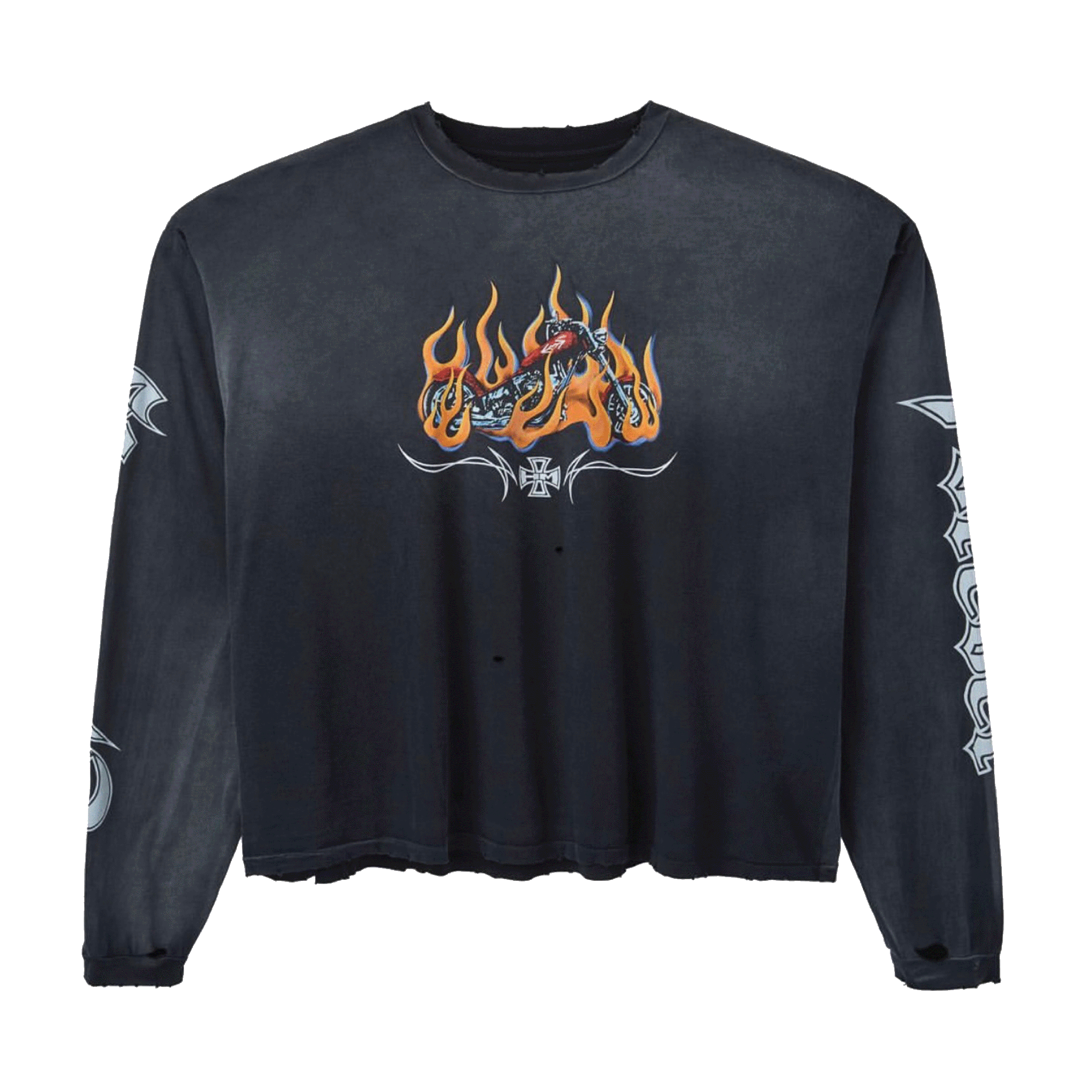
A company’s identity is easiest to protect when it functions happy memories don’t die solo. Each textile pick, every graphic placement, each silhouette choice stays inside one team’s control. The instant a new creative partner comes aboard, compromises start piling up. HMDD clothing has cultivated its identity around specific signals: distressed graphics, oversized silhouettes, and text treatments that reference memory, loss, and time. Those defining markers could easily be flattened into something blander by a partner favoring a bolder, market-friendly look.
This marks the point where discipline emerges as a deliberate edge. Feedback and write-ups originating from the HMDDLA community repeatedly point out that partnership drops keep the brand’s foundational design language — identical fabric heft, an identical distressed-print approach, matching sentimental wording on tags and inserts. This uniformity is no accident. This implies an underlying principle: the collaborator can influence hue or shape, but the emotional throughline stays untouched.
Consider the alternative. If HMDD released a collab hoodie with bright, glossy branding and zero reference to its usual themes, longtime buyers would notice within seconds. The brand’s audience isn’t drawn in by trend-chasing; they’re drawn in by specificity. A single misstep — one collection that feels like merchandise rather than memory — could cost more trust than any short-term sales bump would repay.
What, In Essence, Joint Projects Disclose About HMDD’s Creative Approach
Stylistic tendencies that might under other circumstances go overlooked get spotlighted by each joint release. Any time HMDD partners with someone outside the brand, a few recurring traits recur across nearly all output: dense cotton fabrics (usually in the 280–400 GSM range for hoodies and sweatshirts), loose-fitting shapes, and hand-distressed or tonally washed finishes that impart each piece a worn-in quality rather than a brand-new one. This tendency is especially visible in HMDD sweatpants — relaxed tapering, elasticated rib endings, and a textile touch that leans toward comfort over crisp shaping.
The same reasoning carries over to HMDD shorts. Rather than treating shorts as a filler category, the label carries over the identical distressing techniques and typography choices found on outerwear pieces, which keeps a entire seasonal release read as unified rather than scattered. That consistency across categories — hoodies, sweatpants, shorts, tees — helps explain why shoppers specifically look up “best hmdd clothing” instead of accepting a off-the-shelf streetwear option.
- Textile heft stays dense and weighty, even in summer-suited pieces like shorts.
- Typography relies on handwritten or distressed-stencil styles instead of minimal sans-serif labeling.
- Color palettes lean toward muted blacks, washed greys, and subdued natural tones over bold, punchy hues.
- Graphics nod to memory, time, and impermanence rather than straightforward branding.
Once an outside partner steps into this space, the expectation is that they adopt HMDD’s design vocabulary rather than impose their own. It’s a bigger demand than it seems, and that’s the reason not every pitched collaboration makes it to production.
The Business Logic Behind Selective Partnerships
Streetwear’s market logic prize rarity and penalize excess visibility. A brand that partners with every possible name eventually collaborates with no one memorably. HMDD’s release cadence appears to favor limited quantities and sparsely spaced partnership releases instead of a nonstop flow of co-branded goods. That pacing does two things at once: it protects perceived exclusivity, and it gives the design team enough runway to make sure every partnership remains clearly identifiable as HMDD.
Worth noting too is the pricing strategy at play. Streetwear collab items usually cost more than regular catalog pieces — commonly priced 15–30% higher — because of added production complexity, limited runs, or dual-branding costs. Shoppers who look up an “hmdd review” before purchasing frequently cite value-for-money as decisive, so any collaboration that raises price without raising perceived craftsmanship invites criticism instead of approval.
Because of this the most astute fashion partnerships operate more as shared research-and-development efforts than promotional gimmicks. Both teams combine their methods — maybe one contributes a dye process, the other contributes a silhouette — and the result should feel earned rather than slapped together. If that equilibrium succeeds, both audiences convert into fans of the other brand. Should it fall short, neither group of followers feels prioritized.
Weighing Different Collaboration Strategies
To understand where HMDD positions itself compared with standard streetwear collaboration strategies, it helps to look at a few widely-used approaches adopted across the industry in 2026. The table below lays out three overarching collaboration styles seen in the larger streetwear market, unconnected to specific named partners.
| Collaboration Style | Core Aim | Typical Release Size | Risk to Brand Identity |
|---|---|---|---|
| Repeated co-branding | Increase visibility and traffic | Sizable, recurring batches | Significant — brand character erodes with excessive exposure |
| One-off hype drop | Brief sales surge | Extremely scarce, single run | Moderate — impact fades once hype passes |
| Selective, values-aligned partnership (HMDD’s typical pattern) | Reinforce core identity while engaging adjacent audiences | Limited, occasional | Minimal — partner adapts to brand language rather than supplanting it |
It’s in that third category that HMDD’s partnerships tend to settle. There’s little sign the brand wants to saturate its calendar with joint releases. Instead of that, each partnership appears built to answer a particular creative question — a new fabric treatment, an untried color palette, a fresh take on distressing — while leaving the sentimental center of “happy memories don’t die” fully intact.
The Takeaway for Buyers This Year
For anyone comparing HMDD against other emerging streetwear labels this year, collaborations offer a valuable litmus test. If a collaboration piece still reads as unmistakably HMDD — same fabric weight, same worn typography, same emotional resonance — that signals the brand’s identity is solid enough to survive growth. If future drops start feeling interchangeable with whichever partner is attached, that counts as a warning sign worth monitoring.
Shoppers researching HMDD sweatpants, HMDD shorts, or any collaboration piece should pay attention to a few concrete details before buying: fabric weight specified in the product description, whether sizing runs true-to-size or intentionally oversized, and whether the piece is part of a serialized or limited run. These details are more important in collaboration releases than in routine catalog drops, since collaboration pricing generally lands higher and expectations increase accordingly.
Ultimately, HMDD’s collaborations act as identity checkpoints rather than purely marketing events. Each one asks whether the brand can grow its reach without losing the specific, memory-driven mood that built its following in the first place. The pattern so far points to a brand that cares more about guarding its voice than grabbing every spotlight on offer — and for a label built wholly around emotional resonance, that discipline may be its most valuable asset heading further into 2026.